
Geo Zhou Jie Zhou
Logo Department of Computer Science and Engineering, Michigan State University

I am a Ph. D. student in the Department of Computer Science and Engineering, Michigan State University. My current research is under the supervision of Prof. Zeng, in the INSS lab. Before that, I got my master degree from University of Chinese Academy of Sciences, in Institute of Computing Technology, under the supervision of Dr. Yao. I got my bachelor degree from Beijing University of Technology.

My research interest focus on:

Wireless Sensing: Multimodal sensing using signals like mmWave, Lidar and visible light.

Deep Learning: Neural networks for sensing and planning.


Education
  • Michigan State of University
    Michigan State of University
    Department of Computer Science and Engineering
    Ph.D. Student
    Aug. 2025 - present
  • University of Chinese Academy of Sciences
    University of Chinese Academy of Sciences
    M.S. in Computer Science
    Sep. 2022 - Jul. 2025
  • Beijing University of Technology
    Beijing University of Technology
    B.S. in Electronic Engineering
    Sep. 2018 - Jul. 2022
Honors & Awards
  • Third Prize in National College Student Innovation and Entrepreneurship Annual Conference
    2022
  • Outstanding of Graduation in Beijing Univerisity of Technology
    2022
News
2026
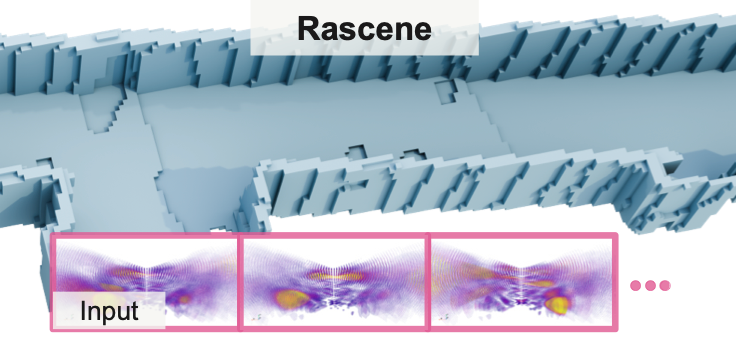
Our paper Rascene: High-Fidelity 3D Scene Imaging with mmWave Communication Signals has been accepted by CVPR 2026.
Feb 21
2025
I joined INSS lab under the supervision of Prof. Zeng in Michigan State of University.
Aug 25
I have graduated from University of Chinese Academy of Sciences and Institute of Computing Technology.
Jul 05
2022
I am pursuing Master Degree in University of Chinese Academy of Sciences, under the supervision of Dr. Ping Yao.
Sep 02
Selected Publications (view all )
Rascene: High-Fidelity 3D Scene Imaging with mmWave Communication Signals

KunZhe Song, Geo Jie Zhou, Xiaoming Liu, Huacheng Zeng

The IEEE/CVF Conference on Computer Vision and Pattern Recognition (CVPR) 2026

Robust 3D environmental perception is critical for applications like autonomous navigation and robotics, yet existing optical sensors like cameras and LiDAR fail in adverse conditions such as smoke, fog, and non-ideal lighting. While specialized radar systems can operate in these conditions, their reliance on bespoke, ultra-wideband hardware and licensed spectrum limits their scalability and cost-effectiveness. This paper introduces Rascene, a novel framework that enables high-fidelity 3D imaging by repurposing ubiquitous mmWave OFDM communication signals. Recognizing that a single-frame RF signal is inherently sparse, noisy, and highly ambiguous, the key innovation of Rascene is a multi-frame 3D imaging framework designed to fuse information from signals captured across multiple, arbitrary poses. This framework leverages a spatially adaptive fusion mechanism to find geometric consensus across the multiple views, effectively suppressing multipath artifacts while preserving sparse geometric details. Experiments demonstrate that our method reconstructs 3D scenes with high precision, providing a new pathway for low-cost, scalable, and robust 3D perception.

Rascene: High-Fidelity 3D Scene Imaging with mmWave Communication Signals

KunZhe Song, Geo Jie Zhou, Xiaoming Liu, Huacheng Zeng

The IEEE/CVF Conference on Computer Vision and Pattern Recognition (CVPR) 2026

Robust 3D environmental perception is critical for applications like autonomous navigation and robotics, yet existing optical sensors like cameras and LiDAR fail in adverse conditions such as smoke, fog, and non-ideal lighting. While specialized radar systems can operate in these conditions, their reliance on bespoke, ultra-wideband hardware and licensed spectrum limits their scalability and cost-effectiveness. This paper introduces Rascene, a novel framework that enables high-fidelity 3D imaging by repurposing ubiquitous mmWave OFDM communication signals. Recognizing that a single-frame RF signal is inherently sparse, noisy, and highly ambiguous, the key innovation of Rascene is a multi-frame 3D imaging framework designed to fuse information from signals captured across multiple, arbitrary poses. This framework leverages a spatially adaptive fusion mechanism to find geometric consensus across the multiple views, effectively suppressing multipath artifacts while preserving sparse geometric details. Experiments demonstrate that our method reconstructs 3D scenes with high precision, providing a new pathway for low-cost, scalable, and robust 3D perception.

All publications